Japanese Summer Festival
A Celebration of Traditional Cultural Arts
Saturday & Sunday, July 18 & July 19, 2026
The Japanese Summer Festival features exhibits, demonstrations and unique performances that appeal to all age groups and foster a better understanding of the Japanese culture.
Festival activities are included with Garden Admission, advanced registration and additional fee required for tea ceremony participation.


2026 Japanese Summer Festival
Schedule Listed below with more updates to come!
Free Admission for Premium Garden Members
Cost of Regular Garden Admission for Basic & Non-Members
Adults $15, Seniors $14, Students & Military $13, 5 & under FREE
Parking Lots Fill Early
Off-Site Parking Located at the College of Medicine
Complimentary Shuttle Service Offered to & from Visitor Center
Food Available for Purchase
Picnic area available during the festival. Bottled water is permitted in the Garden. No other carry-in beverage or food is allowed in the Garden.
Please help us keep the grounds clean by not littering. Please discard all garbage in the trash receptacles on-site.
Performance Schedule
There are three designated performance locations, Pavilion Stage (Location A), Under the Pavilion (Location B) & Pavilion Lawn (Location C). There will also be an additional demonstration area located behind the Visitors Center.
| SATURDAY (Subject to Change) | ||
| TIME | ||
| 10:00 | Ho Etsu Taiko | Location A |
| 10:30 | Awa Odori | Location A |
| 11:00 | Takarazuka | Location A |
| 11:30 | Candy Man | Location B |
| 12:00 | Kyudo Demonstration (Archery) | Location B |
| 12:30 | Iaido Demonstration (Swords) | Location B |
| 1:00 | Big Brush Demonstration (Hekiun Oda) | Location B |
| 1:30 | Ho Etsu Taiko | Location A |
| 2:00 | Takarazuka | Location A |
| 2:30 | Candy Man | Location B |
| 3:00 | Kyudo Demonstration (Archery) | Location B |
| 3:30 | Aikido Demonstration | Location C |
| 4:00 | Awa Odori | Location A |
| 4:30 | Candy Man | Location B |
| 5:00 | Ho Etsu Taiko | Location A |
| SUNDAY (Subject to Change) |
||
| TIME | ||
| 10:00 | Ho Etsu Taiko | Location A |
| 10:30 | Takarazuka | Location A |
| 11:00 | OriHana | Location A |
| 11:30 | Candy Man | Location B |
| 12:00 | Chicago Koto Group | Location B |
| 12:30 | Big Brush Demonstration (Patricia Larkin Green) | Location B |
| 1:00 | Spirit Bomb | Location A |
| 1:30 | Ho Etsu Taiko | Location A |
| 2:00 | Takarazuka | Location A |
| 2:30 | Chicago Koto Group | Location B |
| 3:00 | Candy Man | Location B |
| 3:30 | OriHana | Location A |
| 4:00 | Spirit Bomb | Location A |
| 4:30 | Candy Man | Location B |
| 5:00 | Ho Etsu Taiko | Location A |
Ho Etsu Taiko
We are a collective of musicians with a fresh take on the art of Japanese drumming. We push the envelope through collaborations with other taiko groups, musicians, and culturally focused performance artists while staying grounded in the rich tradition of kumi-daiko. Through our music, we blend the culture of Japanese American taiko with influences that celebrate the diversity of our ensemble. Our mission is to spread joy through every drumbeat by creating music that is true to who we are.
Koto Performance by the Chicago Koto Group
Chicago Koto Group is a traditional Japanese music ensemble that performs light classical pieces and promotes Japanese culture in the Midwest through their music and dress.
Candy Man
Candyman is a traditional cultural performer and a one-man show from Japan. Candyman keeps the audience entertained as he deftly creates intricate candy sculptures with extreme speed while engaging the audience with a variety of magic tricks and stories.
Shodo (Japanese Large Brush Calligraphy with Hekuin Oda)
Hekiun Oda Sensei was born in 1963 and grew up in Kobe City, Japan, a place known for having many shodo masters living there at the time. Oda Sensei began studying shodo at the age of 5 under the shodo master Goun Katsura. Oda Sensei moved to Chicago in 1990, and since then has held many exhibitions and demonstrations at venues including Uniqlo, the Japan Information Center (JIC), and right here at the Japanese Culture Center. In 2009 he established the Oda Japanese Calligraphy School and has taught over 100 students. Oda Sensei obtained the rank of Shihan (the highest rank in shodo) in November 2011 from the Genshin-kai, the Japanese Calligraphy Association in Japan.
Sumi-E (Japanese Large Brush Calligraphy with Patricia Larkin Green)
Patricia Larkin Green moved to Chicago in the 80’s on a scholastic internship at the Netherlands Chamber of Commerce. She is a 1998 graduate of the University of Minnesota, with a BA in Intercultural Communications. While a student at the University of MN she traveled on scholarship to Greece and France to research Greek National Poet Angelo Sikelianos. She later earned a Certificate in Drawing from the School of the Art Institute of Chicago in 2001. In 2011 she founded OpenWall Chicago, an exhibition space in the 47th Ward. In 2024 she was awarded the designation of Shihan Kaku from Genshin-kai (The Japanese Calligraphy Association in Japan). She is an active member of the Sumi-e Society of America and the International Chinese Calligraphy Art and Painting Society, serving as the North America Exhibition Coordinator.
Kyudo (Traditional Japanese Archery)
Kyudo, 弓道, is a traditional Japanese archery. Our school, Heki-ryu Bishu Chikurin-ha (日置流尾州竹林派) kyudo the way taught at Taiyu-sha (躰勇社) in Kyoto, Japan by the Imperial bow makers Shibata, Kanjuro (柴田勘十郎) XX (former) and XXI (current lineage holder) senseis. We, Fuko kyudojo (Windy Tiger kyudojo), has been established by late Kanjuro Shibata XX sensei in 2001 in Chicago north side. Since then, we have been practicing kyudo every week.
Our practice is not competitive in nature. It is purely contemplative in nature like Japanese Tea ceremony or Flower arrangement, and Kyudo is often regarded as Ritsu-zen (Standing meditation). Our focus of the practice is on “polishing our mind’, rather than on marksmanship. Then, the target becomes a mirror reflecting the quality of one’s mind at the moment of the arrow release. We use a bow called yumi made of a combination of bamboo and hard wood and arrow called Ya made of bamboo.
Aikido (the Art of Peace) by the Aikido Association of America
The Japanese martial art of Aikido is a comprehensive system of throwing, joint locking, striking and pinning techniques, coupled with training in traditional Japanese weapons such as the sword, staff and knife. Founded by Morihei Ueshiba early in the twentieth century following his own extensive study of various armed and unarmed martial systems, Aikido represents a potent distillation of centuries of Japanese martial knowledge.
It is one of the most widely practiced budo, or martial way, in the world. However, Ueshiba (commonly called O-Sensei, or “venerable teacher”) was determined that his Aikido be practiced as more than simply a method of fighting. The Japanese martial arts, influenced by the internal and meditative disciplines inherited from India and China, have often carried with them an emphasis on the development of internal, as well as physical, integrity. Wielding the life-taking sword with compassion and insight, the ideal warrior in Japanese thought is more than a simple killing machine; he is a model of uprightness, courage, and loyalty, gladly sacrificing life (but never honor) in the name of principle and duty.
Awa Odori Chicago
The Mikoren Awaodori Troupe was formed in 2015. This community dance group performs Awa odori, a folkdance originating from Tokushima Japan. Aptly named, Miko- “beautiful lake” -ren “dance group”, the community dance group performs in various cultural outreach events and provides instruction to share the joy of this traditional festival folk dance.
Iaido (Japanese Swordsmanship)
Mugai Ryu is a traditional, feudal-era style of swordsmanship founded around 1700 by Tsuji Gatan Sukemochi. The style aims at teaching practical, combative sword techniques, with an emphasis also on Zen and the attainment of enlightenment through swordsmanship. Practice centers on learning the formal sword drawing and cutting solo forms, as well as paired combative forms using partners. More advanced students will have the opportunity to learn forms from other styles, such as the Sekiguchi Ryu and the Niten Ichi Ryu. Iaito (training swords) are optional if owned, otherwise beginners may borrow or purchase wooden training weapons. 6-week Introductory Course and Ongoing Training.
Spirit Bomb
Like Goku’s genkidama, Spirit Bomb gathers its power from all the great anime music in existence to coalesce into an explosive live performance. SPIRIT BOMB is an anime music experience making waves across the US. Japanese American vocalist Ealina SEKINO, guitarist AKIO, bassist ONI, and drummer DAYMO join forces to create an unforgettable live concert experience for anime fans.
Since 2022, SPIRIT BOMB has appeared at many conventions across the US, collaborating with Live Nation to host their “ANIME MUSIC EXPERIENCE” concerts in major city markets. In 2023, Spirit Bomb opened for the breakthrough Japanese female rock band, HANABIE, on their first US tour. Spirit Bomb also debuted their first original song “Asai Yume,” now available on streaming.
Join SPIRIT BOMB and celebrate the magic of Anime through the power of music.
Activity Stations
There will be activity stations set up throughout the Gardens. Please refer to the map for assistance. Activity stations were provided thanks to our friends at the Japanese Culture Center.
There are 7 designated locations where guests can find activities, vendors, or interactive experiences. Conversation Garden (1), Guest House Circle (2), Behind the Visitors Center (3), The Horticulture Shop (4), Near the Pavilion Lawn (5), The Floating Deck (6), & The West Waterfall (7). (Days, schedule, and locations are subject to change)
| SATURDAY (Subject to Change) | ||
| TIME | ||
| 10:00 AM – 4:00 PM | Ikebana | Location 5 |
| 10:00 AM – 4:00 PM | Tiene No Taiko (Anderson Gardens Taiko Drum Club) | Location 3 |
| 10:00 AM – 4:00 PM | Karesansui Garden Station (Raked Zen Gravel Gardens) | Location 7 |
| 10:00 AM – 12:00 PM | Anime Drawing Station | Location 4 |
| 10:30 AM – 12:30 PM | Japanese Paper Making – Supplies Limited | Location 1 |
| 12:00 PM – 2:00 PM | Origami Station | Location 4 |
| 1:00 PM – 3:00 PM | Japanese Paper Making – Supplies Limited | Location 1 |
| 2:00 PM – 4:00 PM | Japanese Name Writing | Location 4 |
| SUNDAY (Subject to Change) |
||
| TIME | ||
| 10:00 AM – 4:00 PM | Ikebana | Location 5 |
| 10:00 AM – 4:00 PM | Tiene No Taiko (Anderson Gardens Taiko Drum Club) | Location 3 |
| 10:00 AM – 4:00 PM | Karesansui Garden Station (Raked Zen Gravel Gardens) | Location 7 |
| 10:00 AM – 12:00 PM | Anime Drawing Station | Location 4 |
| 10:30 AM – 12:30 PM | Japanese Paper Making – Supplies Limited | Location 1 |
| 12:00 PM – 2:00 PM | Origami Station | Location 4 |
| 1:00 PM – 3:00 PM | Japanese Paper Making – Supplies Limited | Location 1 |
| 2:00 PM – 4:00 PM | Japanese Name Writing Station | Location 4 |
Teien No Taiko - Drums of The Garden
Taiko (太鼓) are a broad range of Japanese percussion instruments. In Japanese, the term taiko refers to any kind of drum, but outside Japan, it is used specifically to refer to any of the various Japanese drums called wadaiko (和太鼓, lit. “Japanese drums”) and to the form of ensemble taiko drumming more specifically called kumi-daiko (組太鼓, lit. “set of drums”). The process of constructing taiko varies between manufacturers, and the preparation of both the drum body and skin can take several years depending on the method.
Taiko have a mythological origin in Japanese folklore, but historical records suggest that taiko were introduced to Japan through Chinese and Korean cultural influence as early as the 6th century CE; pottery from the Haniwa period depicting taiko drums has also been found. Some taiko are similar to instruments originating from India. Archaeological evidence also supports the view that taiko were present in Japan during the 6th century in the Kofun period. Their function has varied throughout history, ranging from communication, military action, theatrical accompaniment, religious ceremony and concert performances. In modern times, taiko have also played a central role in social movements for minorities both within and outside Japan.
Ikebana
Origami Station
Ty Yamamoto is a Chicago-based filmmaker, photographer, and Japanese teacher with a passion for the art of folding paper. Ever since childhood, Ty has loved folding all sorts of intricate paper creations. Over the past year, Ty has taught virtual origami lessons to people of all ages, bringing the traditional Japanese art form to households all over the world.
Shodo Station
More Information coming soon!
Anime Station
In this workshop, participants will learn the basics of anime-style art. We will focus on how to shape faces, including eyes, hair, and expressions. Join the JCC during this workshop to learn the history of Anime and create your very own anime character!
Japanese Name Writing Station
More information coming soon!
Karesansui Garden Raking
More information coming soon! This station will be held at our West Waterfall location
Tea Ceremonies
Tea ceremonies are hosted by Kimiko Gunji, Professor Emeritus of Japanese Arts & Culture in the School of Art & Design at the University of Illinois at Urbana-Champaign, and the Anderson Japanese Gardens Tea Study Group. Gunji Sensei is also the retired director of Japan House at the University. Advanced Registration for all ceremonies is required and space is limited at each tea ceremony.
There are three designated tea ceremony locations, each offering a different Chado experience. Chado means ‘the way of tea” and is a spiritual and aesthetic discipline that fosters peace and connection between the host and guests. At the Guest House, tea will be presented in the Misonodana table style, allowing guests to enjoy the ceremony sitting on the tatami mats indoors with an air-conditioned view of the karesansui garden. At our traditional and cozy Tea Hut, guests may sit seiza or cross-legged as the host prepares a bowl of tea. At the Gazebo, guests will enjoy the sounds of nature and the nearby waterfall, sitting comfortably on shaded bench seats as their tea host prepares a bowl of tea.
Tea Ceremony Registration includes admission to the Garden for the date of your Tea Ceremony
Participants are asked to check in at the registration cart in the Guest House Circle (Location 2) 20 minutes before their tea ceremony time.
Regular Tea Ceremonies
$35.00 for Garden members | $40.00 for non-members
Special Tea Ceremony with Professor Gunji
$40.00 for Garden members | $45.00 for non-members
The deadline to register for tea ceremony participation is Wednesday, July 15, at 5:00 PM. Anything cancelled after this time will not be eligible for a refund.
SATURDAY
GUEST HOUSE
SPECIAL TEA w/ Professor Gunji
Takes place in the Guest House
GAZEBO
TEA HUT
SUNDAY
GUEST HOUSE
SPECIAL TEA w/ Professor Gunji
Takes place in the Guest House
GAZEBO
TEA HUT
Food and Vendors
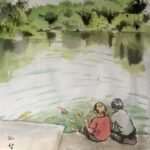
Satomi’s Atelier
Some people say my paintings have a “nostalgic,” “scenic,” or “peaceful” feeling. It would be an honor if my paintings brought “peace” to your heart.
Visit Satomi near the pavilion lawn (Location 5 on Map), All day Saturday and Sunday.

Food Vendors and Picnic Tables can be found by the East Parking Lot
Food Vendors Subject to Change